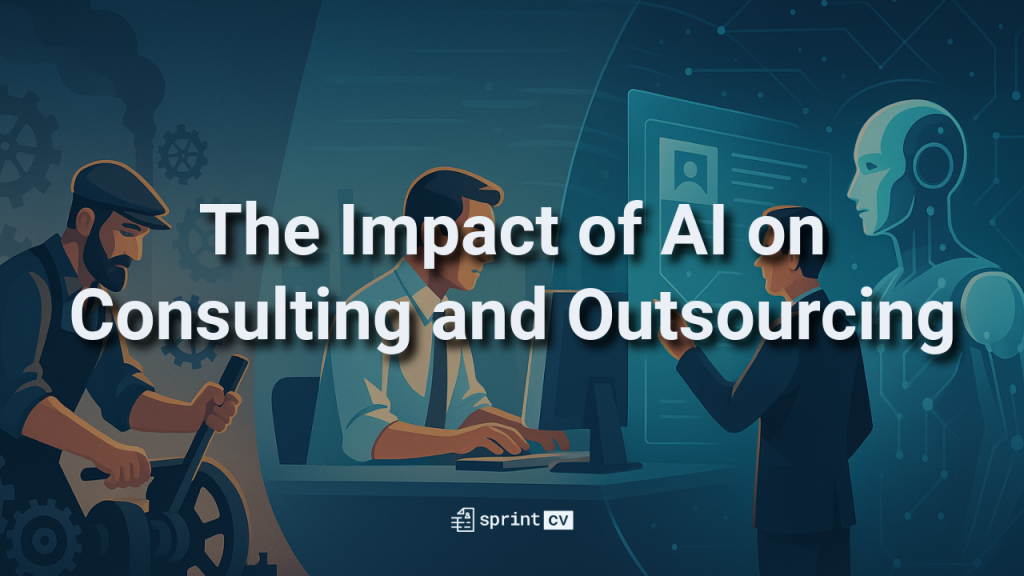

Every few decades, a new technology emerges that completely changes how we live and work. It challenges old habits, sparks fear, and forces industries to reinvent themselves. We saw it with the Industrial Revolution, the rise of computers, and the explosion of the internet. Now, it’s Artificial Intelligence (AI) that’s reshaping the world. Many consulting and outsourcing companies are asking the same question: Will AI replace consultants, developers, and service professionals? It’s a valid concern. Every major innovation brings disruption, uncertainty, and doubt. But history shows that disruption rarely destroys industries – it transforms them. Today, we will take a look at the impact of AI on consulting and outsourcing.
Learning from the Past
When computers were first introduced, people feared massive job losses. Secretaries, accountants, and engineers thought machines would take over their work. Instead, computers created entirely new industries and job categories. Roles like IT administrators, software developers, data analysts, and digital marketers didn’t even exist before computers.
The same pattern occurred during the Industrial Revolution. Machines replaced repetitive manual labor, yes, but they also increased productivity, reduced costs, and created new types of work. Manufacturing exploded. Demand grew. Employment shifted to higher-value roles.
History repeats itself. Every major shift brings new challenges, but also enormous opportunities. AI is doing for services what the Industrial Revolution did for manufacturing.
From Manual Work to Intelligent AI
The Industrial Revolution automated physical work. AI is automating cognitive and administrative work. Think about a typical office in public administration. People spend hours moving digital files, classifying folders, sending repetitive emails, and filling out standard forms. These are routine, low-value tasks.
AI can handle them all, instantly. It can categorize, process, and route documents automatically. It can check for consistency, extract data, and organize files at a speed no human can match. That doesn’t make people obsolete – it makes them free. Free to focus on problem-solving, strategy, creativity, and human connection. These are the areas where we, as humans, truly shine.
The Impact of AI and the Future of Consulting and Outsourcing
In consulting and outsourcing, efficiency and speed are everything. The faster and more accurately you can deliver results, the more competitive you are. AI won’t replace consultants (or, on the other side of the coin, recruiters). But consultants who use AI will replace those who don’t.
A developer who understands how to use AI effectively can be up to four times faster than one who doesn’t. Instead of spending hours coding repetitive logic, they can ask AI to generate boilerplate code, create test cases, or write documentation.
This gives them more time to focus on the creative part: designing architecture, solving complex problems, and delivering value. At our company, we see this transformation happening daily. AI allows us to help others automate the process of preparing and formatting CVs. Internally, AI completely changed our creative workflow. What once took 30 minutes now takes less than two.
On our clients case, the recruiter still reviews and adjusts the final result, but 90% of the work is already done. The time saved can be reinvested in what really matters: people, conversations, and results.
AI and the Fear of Job Loss
Whenever a new technology appears, people fear losing their jobs. But the reality is that when efficiency increases, demand usually increases too.
Take the car industry as an example. Before automation, cars were handmade and expensive – only for the rich. After industrial automation, production costs dropped dramatically. Cars became affordable, demand exploded, and factories multiplied. The same logic applies to AI and to the impact of AI on consulting and outsourcing.
If services become faster and cheaper, more companies will use them. Demand for consultants, engineers, and specialists will grow. New niches will appear. Yes, repetitive roles will fade, but they’ll be replaced by higher-level positions: AI supervisors, data specialists, prompt engineers, and business strategists who know how to leverage technology.
Why Companies Should Embrace AI, Not Fear It
The worst decision a company can make right now is to resist change. In business, staying still means falling behind.
Look at the Nordic countries. Because labor costs are high, they were among the first to adopt automation: self-checkout supermarkets, automated tolls, and gas stations without attendants. The result? Greater efficiency, better customer experience, and higher profitability. AI will do the same for services.
Administrative tasks, HR operations, recruitment processes, customer support – all will be streamlined through intelligent systems. Humans will still be needed, but for supervision, exception handling, and relationship management. The heavy lifting will be done by AI.
Companies that adapt quickly will operate faster, leaner, and smarter. Those that cling to old methods will be left behind.
The Human Role: From Doing to Deciding on Consulting and Outsourcing
AI doesn’t eliminate humans – it elevates them. Machines are built for consistency and speed. Humans bring judgment, empathy, and creativity. The combination of both is where real innovation happens.
At Sprint CV, AI proposes solutions, but humans make the final call. For example, our system automatically suggests how a CV should be structured based on company best practices. But the recruiter still reviews, personalizes, and approves the final version.
It’s a perfect example of collaboration. The machine accelerates the process; the human adds quality, nuance, and meaning. That’s the future of work: humans and machines working together, each doing what they do best.
Accepting the Impact of AI and it’s Changes
The companies that will win are those that accept change, not fear it. AI is not about replacing people. It’s about freeing them from repetitive work.
The reality is that jobs will evolve, not disappear. Professionals will need to learn how to use AI tools effectively – to become “AI-powered” versions of themselves. That requires a shift in mindset: from fear to curiosity, from denial to experimentation.
Because in the end, AI is just a tool. It still needs guidance, purpose, and ethical direction. Those come from people.
What a Future Impacted by AI Holds for Consulting and Outsourcing
AI won’t destroy consulting or outsourcing – it will redefine them. Projects will be delivered faster and with higher quality. Recruiters will spend more time with candidates and less time formatting documents. Developers will focus on strategy and architecture instead of boilerplate code.
We’ll see new types of companies and new kinds of jobs. And those who embrace AI early will have a massive competitive advantage!
Final Thoughts
The Impact of AI on Consulting and Outsourcing is not their end – it’s the next step in their evolution. Just as machines transformed manufacturing, AI is transforming services. It’s not a threat, it’s an opportunity: to work smarter, to deliver faster, and to create more value.
Yes, disruption is uncomfortable. But so was electricity, the computer, and the internet. The companies that embrace AI with the right mindset – one of curiosity, measurement, and improvement – will not only survive but thrive.
At the end of the day, AI doesn’t replace people. It replaces inefficiency. And that’s how progress is made.
Curious to see how AI can impact your recruitment workflow? Book a free demo with us!
Cloud Software
Berita Olahraga
Lowongan Kerja
Berita Terkini
Berita Terbaru
Berita Teknologi
Seputar Teknologi
Berita Politik
Resep Masakan
Pendidikan


