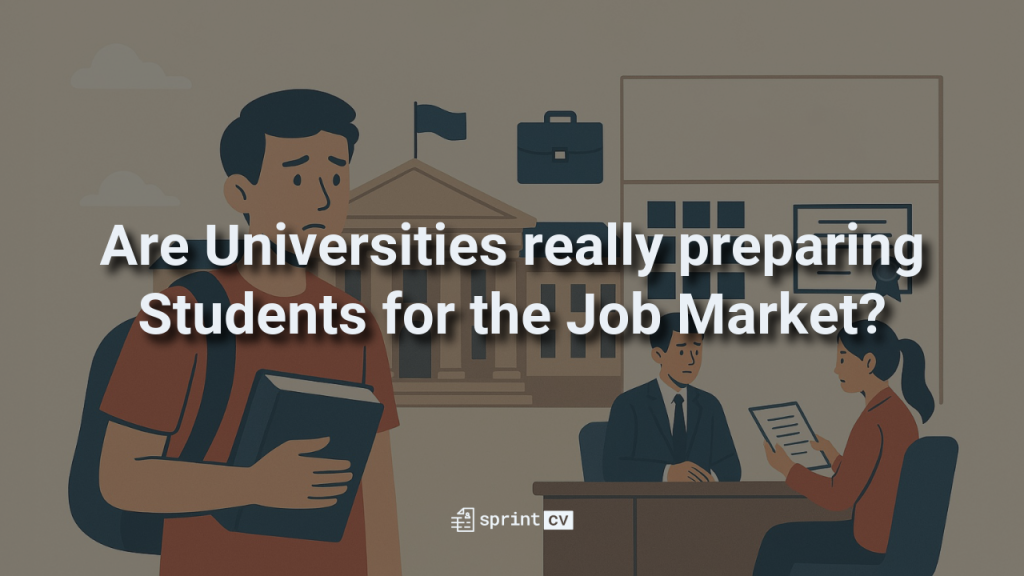

Across the world, and especially in Portugal, younger generations have greater and easier access to higher education than ever before. Statistically, this is an extraordinary step forward. More students are earning degrees, and more opportunities are opening up across fields that once felt out of reach. From business management to data science, law, and medicine, the educational pathways are broader and more inclusive. Yet, despite this progress, an essential question remains: are universities actually preparing their students for the job market?
Think about it carefully. How many universities offer practical crash courses that teach students how to correctly structure and format a CV so that recruiters can easily read and assess it? Very few do. And yet, this is one of the most fundamental skills a graduate needs to transition successfully from academia into the professional world. Degrees showcase knowledge, but a CV showcases employability. Without understanding how to communicate their skills effectively, many graduates struggle to take that crucial first step toward their careers.
The Gap Between Universities and the Job Market
The problem does not begin at graduation. It starts much earlier, within the educational system itself. Most Universities fail at preparing students for the job market. Schools rarely, if ever, teach students how to build a CV that aligns with industry expectations or how to present themselves in a way that appeals to recruiters. There is a profound gap between what students learn and what the job market demands.
Every sector has its own unique norms and standards. A CV for a software developer will look entirely different from one written by a marketing specialist, a lawyer, a designer, or a nurse. However, students are rarely exposed to these nuances. They spend years mastering theoretical frameworks, memorizing formulas, and studying abstract concepts, while lacking the practical career tools that can determine whether they secure their first job or not.
This is not just a local issue. Across Europe, North America, and beyond, universities are producing talented graduates who often lack the soft skills and career readiness required by modern employers, thus not preparing them for the real life industry. Many enter the workforce unprepared for the realities of recruitment processes, unaware of applicant tracking systems, and confused about how to highlight their strongest attributes.
After investing three, four, or even more years of effort, time, and money, graduates often face rejection due not to lack of ability, but to lack of preparation in the areas that matter most to employers. The result is frustration, unemployment, and a growing sense of disconnection between academia and the corporate world.
Why CV Writing Skills Matter
From a recruiter’s perspective, the situation can be equally discouraging. Recruiters review hundreds, sometimes thousands, of CVs every week. Many are poorly formatted, inconsistent, or cluttered with graphics, icons, and irrelevant details that confuse automated systems and human readers alike. This is another proof that universities are not properly preparing their students to create industry standard CVs.
A CV is not just a list of experiences; it is a professional narrative. It tells a story about who the candidate is, what they have accomplished, and where they want to go. When a CV lacks clarity or structure, it sends the wrong message. To recruiters, it signals a lack of professionalism, poor attention to detail, and sometimes even a lack of genuine interest in the opportunity being offered.
This leads to an important question: why are universities not teaching students how to create CVs that work? Career readiness programs should be an essential part of higher education. Understanding how to present one’s achievements and skills should be considered as important as mastering theoretical knowledge.
Many institutions pride themselves on academic excellence, research output, and innovation, yet overlook this crucial bridge between education and employment. Teaching students to craft effective CVs, to prepare for interviews, and to build personal brands online could significantly improve university employability rates. It is not enough to graduate; students must learn to position themselves strategically within the market.
The Growing Importance of Career Readiness for Students
The world of work is evolving faster than ever. Technology, automation, and artificial intelligence are transforming industries, creating new roles while making others obsolete. Employers now seek adaptable, self-driven professionals with problem-solving abilities, communication skills, and emotional intelligence. Yet again, universities are not preparing their students for this ever changing industry: these qualities are rarely taught explicitly in traditional classrooms.
Career readiness is no longer optional; it is fundamental. Students who graduate with strong technical knowledge but lack interpersonal and organizational skills often find themselves at a disadvantage. Modern recruiters look for candidates who can demonstrate initiative, critical thinking, and the ability to work well in dynamic environments.
By integrating employability training into university curricula, institutions could better equip their students to face the demands of this evolving job market. Courses on professional communication, teamwork, and time management would not only improve individual prospects but also raise the overall reputation of universities as places that truly prepare students for life after graduation.
Generational Shifts: A New Challenge for Universities and Students
Older generations often struggle to relate to the challenges faced by today’s graduates. For many of them, getting a job was more straightforward. They wrote their CVs in simple formats, handed them directly to employers, and often received feedback in person. The competition was intense, but the process was personal and predictable.
The reality for younger generations is completely different. Today’s graduates must compete with thousands of applicants for the same position, many of whom have similar qualifications and experiences. They must also navigate complex online systems, tailor their CVs to match automated filters, and build a digital presence that aligns with their professional goals.
Applicant tracking systems have changed the recruitment landscape. A candidate’s CV can be automatically rejected before a human even sees it if it does not include the right keywords or formatting. In this environment, understanding how to create an ATS-friendly CV is not just useful; it is essential.
This growing complexity has made the transition from education to employment more stressful and competitive than ever. Without proper guidance from universities, graduates are left to figure it out on their own, relying on online tutorials, trial and error, or expensive career coaching services. This imbalance between generations underscores the urgent need for structured, practical career preparation within higher education.
The Way Forward: Bridging the Gap
If we truly want to set graduates up for success, universities and schools must rethink their approach to career education. Universities should pair academic excellence with employability training. Institutions should offer dedicated workshops on CV writing, interview techniques, personal branding, and job search strategies.
Universities could collaborate more closely with companies, recruitment platforms, and career development services to align their teaching with real-world expectations. Internship programs, mentorship opportunities, and career fairs should be treated as integral components of the learning experience rather than optional extras.
By encouraging students to engage with professional development early in their studies, universities would help them build confidence and clarity about their career paths. A student who understands how to market their skills effectively will always have an advantage in the job market.
Platforms that simplify the process of CV creation and optimization, such as those using artificial intelligence or data-driven formatting recommendations, can also play a crucial role. These tools help students save time, reduce errors, and ensure their applications stand out in an increasingly competitive environment.
Until such programs become standard practice, students and young professionals must take proactive steps to bridge the gap themselves. They can seek mentorship, use online resources, and explore tools designed to improve CV quality and job search success. Investing time in learning how to communicate one’s strengths is one of the most valuable decisions any graduate can make.
Because in today’s competitive job market, having a degree is no longer enough. The way a candidate presents themselves on paper and online can determine whether they land their dream job or employers overlook them. True education goes beyond knowledge; it prepares individuals to apply that knowledge confidently and effectively in the real world.
Final Thoughts – Are Universities Really Preparing Students?
Universities have a responsibility that extends beyond providing academic instruction. They shape future professionals, leaders, and innovators. To fulfill that mission fully, they must prepare students not only to think critically but also to act strategically in their careers.
Bridging the gap between academia and the job market is not a simple task, but it is a necessary one. By integrating employability training and emphasizing practical career readiness, universities can ensure that their graduates leave not only with degrees but with the confidence and competence to thrive in any professional setting.
The next generation of workers deserves an education that empowers them to transform knowledge into opportunity. Only then can higher education truly claim to be preparing students for the world that awaits them.
At Sprint CV, we help recent graduates build standout CVs using a wide range of professional templates. Now, imagine if universities started using our platform to teach students how to present themselves effectively. Wouldn’t graduates be better prepared for the job market from day one?
If you’re a student, don’t wait try Sprint CV today and see the difference for yourself.
Cloud Software
Berita Olahraga
Lowongan Kerja
Berita Terkini
Berita Terbaru
Berita Teknologi
Seputar Teknologi
Berita Politik
Resep Masakan
Pendidikan


