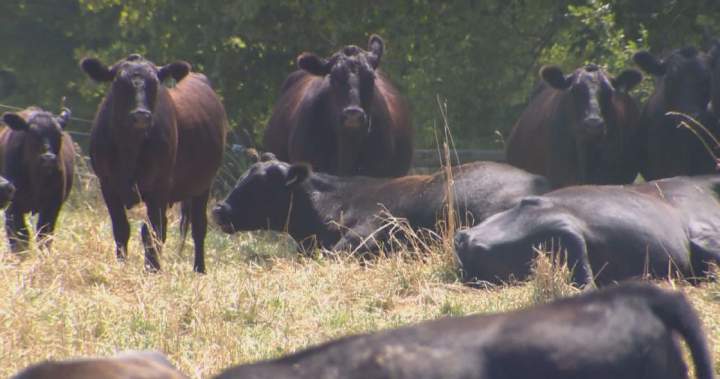

Recent restrictions placed on imports of Texas will not have a significant impact on cattle production in Canada for now, according to the national association for the country’s beef producers.
The New World screwworm, the parasite at the centre of the import restrictions, can have devastating consequences, but Canada won’t bear the brunt of it, said Leigh Rosengren, the chief veterinary officer for the Canadian Cattle Association.
While Canada trades cattle with U.S. states, very little of it comes from Texas, Rosengren said.
“Most of the imported cattle come from the northern states, so we’re not expecting major disruptions to the flow of animals,” Rosengren said.
“We do not have the screwworm in Canada, but vigilance and increased surveillance is important. Watching for open wounds – festering wounds that are not healing that are not healing is very, very important.”
Cattle-related concerns were prompted after the Canadian Food Inspection Agency (CFIA) placed temporary limits on the import of livestock from the state of Texas on Friday. The CFIA said animals, including horses, that originate from or were present in Texas within 21 days prior to arriving at the Canada-U.S. border will not be accepted into Canada.
The restrictions were placed after a calf in the southern U.S. state was confirmed to have New World screwworms on it last week. Since this case, additional instances, including one involving the parasites on a dog, were confirmed in Texas and New Mexico by the U.S. Department of Agriculture (USDA) on Monday.

Get weekly health news
Receive the latest medical news and health information delivered to you every Sunday.
The dog, which the USDA initially reported as a Texas case, lives in New Mexico. It was reclassified as the first in that state.
Five cases of the parasites have been confirmed by the USDA thus far.
“The impacts on the infected, or infested, animals themselves are quite dramatic. This parasitic fly is unique in that it can lay eggs, which then feed on living flesh,” Rosengren said.
Screwworm larvae burrow into the flesh of warm-blooded animals, including livestock and pets, and eat the living tissue, she explained.
These maggots can “cause serious, often deadly damage,” according to the CFIA.
An adult New World screwworm is pictured. The parasitic flies were found in Texas and New Mexico in the U.S. and were said to prefer warm, humid climates.
(Denise Bonilla/U.S. Department of Agriculture via AP)
Screwworms cannot survive cold Canadian winters, the CFIA said. The agency says the flies prefer warmer, humid temperatures and are endemic to South America and the Caribbean.
“You really feel for the producers (in Texas) … it’s devastating,” said Erin Murphy-Thompson, a rancher in Alberta. “It seems far away, but our cattle market is so integrated with the U.S. —there’s a lot of movement of animals. I mean, even for rodeo stock that come up and do the rodeo circuit.”
In Mexico, there has been an outbreak of the screwworm since 2024, according to a news release shared by the North American Invasive Species Management in November of that year. Some market impacts were felt as a result.
Rosengren said she believes the “market has already priced in this situation” for Canadians, though the rancher shared a different assessment.
“Prices are up like 60 per cent right now on beef, on cattle, and it’s because there’s a shortage of supply. So, anything that limits our supply coming in can raise the prices again, but also if a disease or parasite gets into our market, and then we have closures to countries,” said Murphy-Thompson.
Ultimately, maintaining good biosecurity and surveillance is the right approach, according to Rosengren.
“Those best management practices apply for any pest or disease. Therefore, if producers implement those best-management practices, they protect themselves from a plethora of risks,” Rosengren said.
The association’s veterinary officer says Canadian cattle producers are unlikely to see cattle with screwworms, but they should monitor for other pests, such as Asian longhorn ticks.
– With files from Global’s Sean Boynton and The Associated Press
© 2026 Global News, a division of Corus Entertainment Inc.
PakarPBN
A Private Blog Network (PBN) is a collection of websites that are controlled by a single individual or organization and used primarily to build backlinks to a “money site” in order to influence its ranking in search engines such as Google. The core idea behind a PBN is based on the importance of backlinks in Google’s ranking algorithm. Since Google views backlinks as signals of authority and trust, some website owners attempt to artificially create these signals through a controlled network of sites.
In a typical PBN setup, the owner acquires expired or aged domains that already have existing authority, backlinks, and history. These domains are rebuilt with new content and hosted separately, often using different IP addresses, hosting providers, themes, and ownership details to make them appear unrelated. Within the content published on these sites, links are strategically placed that point to the main website the owner wants to rank higher. By doing this, the owner attempts to pass link equity (also known as “link juice”) from the PBN sites to the target website.
The purpose of a PBN is to give the impression that the target website is naturally earning links from multiple independent sources. If done effectively, this can temporarily improve keyword rankings, increase organic visibility, and drive more traffic from search results.