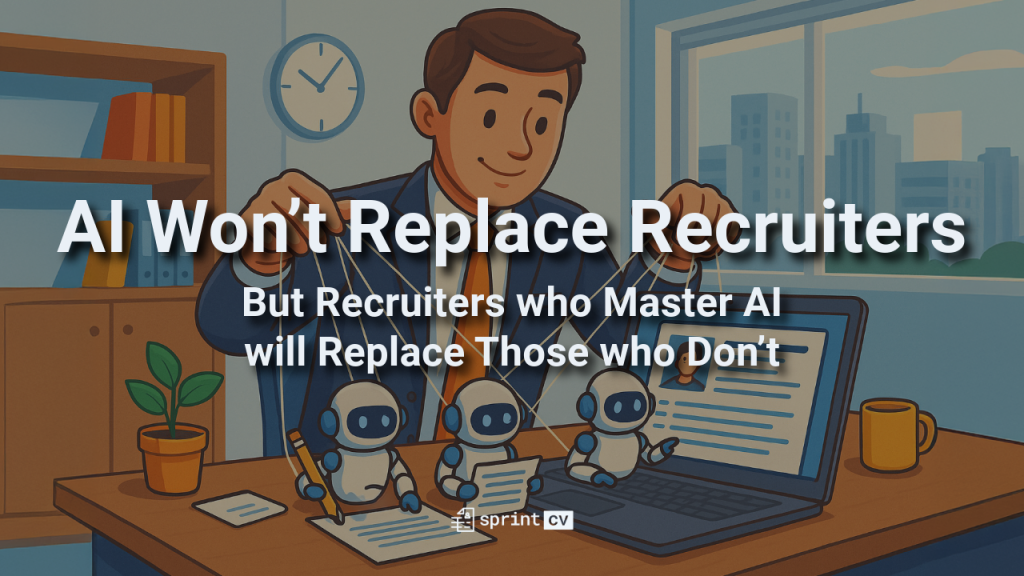

In the ever-evolving world of tech recruitment, artificial intelligence (AI) has evolved from a futuristic concept to a daily reality. The conversation is no longer about whether AI will transform the industry. It’s already happening! The real question is: who will thrive in this new landscape?
Recruiters who learn how to master AI tools are already standing out. Those who ignore them are being left behind. AI isn’t coming to take your job, but it will dramatically change how you do it.
AI as the ultimate recruitment assistant
For years, recruiters have juggled countless repetitive tasks: parsing CVs, formatting profiles, copying data between systems, and preparing candidate summaries. These steps are essential, but they don’t require deep expertise.
AI tools now automate much of that heavy lifting in seconds. For example, companies processing tens of thousands of CVs per year used to spend around 30 minutes on each one. With AI-powered parsing and formatting, the same work can be done in under two minutes, saving thousands of hours annually.
Imagine saving 20,000 hours of manual work in a year. That’s the power of automation done right. The result isn’t fewer recruiters, it’s more efficient teams who can focus on what matters: engaging with candidates, building relationships, and making better hiring decisions.
Mastering AI is the new professional edge
Let’s be clear: AI doesn’t make great recruiters obsolete. It amplifies their strengths.
Recruiters who understand how to prompt AI effectively, who can validate and refine its output, and who remain critical thinkers will be the ones setting the standard. Meanwhile, those who rely only on “brute force” and endless manual tasks will fall behind.
It’s no different from how top developers use AI coding assistants today. A senior developer who understands how to guide AI can deliver the work of four people. But without that expertise, AI will just produce mediocre code that needs fixing.
The same logic applies to recruitment. A senior recruiter who knows how to use AI becomes faster, sharper, and more strategic. AI enhances judgment; it doesn’t replace it.
The shifting role of juniors and seniors in recruitment
One of the most significant changes AI brings to recruitment is the shift in how teams are structured. Traditionally, junior recruiters handled repetitive tasks: posting job ads, formatting CVs, screening profiles, and scheduling interviews. Seniors focused on evaluation, negotiation, and client relationships.
Now, AI can take over most of those repetitive tasks. This means juniors will need to upskill fast. The new “entry-level” recruiter must be comfortable using automation tools, understanding data, and prompting AI efficiently. Instead of asking juniors to “copy and paste,” teams will ask them to train AI, analyse results, and interpret candidate data. The juniors who learn to work with AI will still grow. Those who don’t may struggle to find their place.
For seniors, AI is a force multiplier. With the right tools, one senior recruiter can handle multiple projects that once required an entire team. But that also means seniors must evolve too and become AI mentors, not just people managers.
AI as a cost saver and a productivity booster
Recruitment has always been about efficiency. Time-to-hire, cost-per-hire, and candidate quality, these metrics define success. AI directly impacts all of them. Think about it:
- Speed: Tasks that once took hours now take minutes.
- Accuracy: AI parsing reduces human error and ensures consistent data quality.
- Scalability: Recruiters can manage higher volumes without burnout.
- Engagement: Freed from admin work, teams can focus on building relationships.
From a business perspective, AI is an investment with instant return on investment (ROI). Even a modest monthly subscription to an AI tool can save the equivalent of several full-time salaries. Companies using AI in recruitment aren’t replacing humans; they’re reinvesting time into strategy, culture, and innovation.
Facing the anxiety around AI in recruitment
It’s natural for professionals to feel anxious about these changes. When people hear “AI can replace 10 employees,” it sounds threatening. But context matters: AI doesn’t replace talent, it replaces tasks. That anxiety often comes from uncertainty. What will my role look like in two years? How much of my work can AI really do? The truth is: you decide.
The recruiters who embrace AI as a tool, not a threat, are already using it to become more valuable. They’re faster, more informed, and more creative, precisely because they no longer waste time on repetitive steps. Instead of fearing AI, it’s time to learn how to collaborate with it.
Practical ways recruiters can master AI
If you’re in recruitment, here’s how to stay ahead:
- Start small: Begin with one AI task like CV formatting or job description writing, and make it part of your workflow.
- Learn prompt design: How you ask AI matters. Experiment with prompts and refine them.
- Keep a human layer: AI drafts, you perfect. Always review tone, relevance, and accuracy.
- Track your gains: Measure how much time AI saves and how it improves quality.
- Share knowledge: Discuss tools and workflows within your team. Collective learning accelerates mastery.
Mastery doesn’t come overnight, but consistency pays off quickly.
The ethical side of AI recruitment
With great power comes great responsibility. As AI becomes more embedded in hiring, ethical concerns will rise: bias, transparency, and data privacy.
Recruiters who master AI not only need technical skills but also ethical awareness. They should know how to audit AI decisions, ensure fairness, and maintain human oversight.
The future of recruitment isn’t about replacing people with algorithms. It’s about making sure algorithms serve people better.
The future belongs to the AI-powered recruiter
The future of recruitment isn’t dystopian. It’s empowering! AI won’t replace recruiters. It will empower them to work smarter. Those who learn to combine human intuition with AI efficiency will be unstoppable. Recruitment will always need empathy, critical thinking, and strategic vision, things AI can’t replicate. But the day-to-day execution? That’s where AI shines.
So whether you’re a recruiter, a delivery manager, or a team lead, one truth stands clear:
AI won’t replace you. But someone who knows how to use it might.
Start learning now, and make AI your strongest ally in 2025 and beyond.
How Sprint CV helps recruitment teams
Sprint CV was built to solve one of recruitment’s most time-consuming problems: CV management. Its AI CV Parser allows recruiters to update and adapt any CV to a company-branded version within minutes, ready to submit to clients. Instead of forcing candidates to fill in templates manually (a process that often leads to drop-offs and frustration), recruiters can do 95% of the work automatically. They can then focus on personalisation, ensuring that each CV truly represents the candidate’s experience and skills.
For companies handling thousands of candidates a year, the time savings are enormous. We’re talking about thousands of hours recovered and a team that becomes more efficient, agile, and scalable. Beyond productivity, Sprint CV also brings structure and visibility:
- Every CV follows the same standard and quality.
- Data stays centralised and searchable.
- Collaboration between recruiters, managers, and sales teams improves.
It’s the kind of intelligent automation that turns chaos into clarity. If you’d like to see how your recruitment team could save time and boost efficiency, try Sprint CV today.
Cloud Software
Berita Olahraga
Lowongan Kerja
Berita Terkini
Berita Terbaru
Berita Teknologi
Seputar Teknologi
Berita Politik
Resep Masakan
Pendidikan


