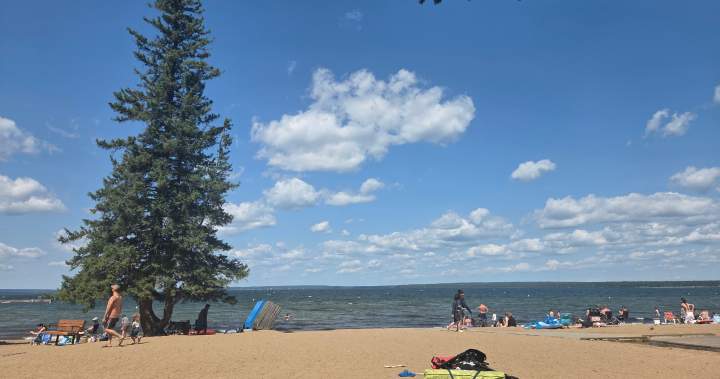

Seeing wildlife is part of the appeal for visitors to Prince Albert National Park. But this summer, visitors say encounters and tensions with wild animals are on the rise. It has many wondering what’s behind the increase as experts remind people to stay safe.
It’s not unusual to see wildlife in Waskesiu, Sask. For many visitors, it’s part of the experience. But this year seems different. Many people see the presence of animals like elk mixing ways not seen before, and they’re not sure why.
Earlier this summer, beachgoers watched in disbelief when several elk decided to cool off right at crowded main beach. The large animals waded around in the water while kids splashed around with their parents just metres away.
Many are also noticing more and more elk wandering within the townsite. But when an animal becomes agitated, a close encounter can quickly turn into a frightening experience, just as it did for visitors passing by Dave King’s place.
“And we warned them that there was a couple of elk down at the lakefront, that were with a young one, that were very owly. And the elk came charging up the shoreline, chasing the people,” King said.

Get daily National news
Get daily Canada news delivered to your inbox so you’ll never miss the day’s top stories.
King allowed the couple to seek refuge in his home and everyone was fine. But some will suggest that this incident is an important reminder.
Todd Smith with the Saskatchewan Wildlife Federation says even though elk may seem comfortable around people, they’re still unpredictable, wild animals.
“They have their own kind of personality traits. Their attitudes, their tolerance levels, will change from day to day,” said Smith.
Earlier in the spring, the park posted signs warning visitors of aggressive elk. They also use other tools like hazing to try and deter them from the townsite.
Parks Canada declined to comment further, but did note elk “begin mating season in the fall, making potential human-elk encounters much more dangerous.”
Still, many are left to wonder why there are so many elk this year.
Smith thinks it might have something to do with last year’s wildfires, reducing natural habitat, concentrating more wildlife into the park.
“A lot of the habitat was reduced, so we get some higher concentrations, be it bears, elk or other wildlife, within the remaining habitat,” Smith said.
Until those habitats regenerate, Smith strongly urges people to enjoy the wildlife, but from a safe distance.
© 2026 Global News, a division of Corus Entertainment Inc.
PakarPBN
A Private Blog Network (PBN) is a collection of websites that are controlled by a single individual or organization and used primarily to build backlinks to a “money site” in order to influence its ranking in search engines such as Google. The core idea behind a PBN is based on the importance of backlinks in Google’s ranking algorithm. Since Google views backlinks as signals of authority and trust, some website owners attempt to artificially create these signals through a controlled network of sites.
In a typical PBN setup, the owner acquires expired or aged domains that already have existing authority, backlinks, and history. These domains are rebuilt with new content and hosted separately, often using different IP addresses, hosting providers, themes, and ownership details to make them appear unrelated. Within the content published on these sites, links are strategically placed that point to the main website the owner wants to rank higher. By doing this, the owner attempts to pass link equity (also known as “link juice”) from the PBN sites to the target website.
The purpose of a PBN is to give the impression that the target website is naturally earning links from multiple independent sources. If done effectively, this can temporarily improve keyword rankings, increase organic visibility, and drive more traffic from search results.