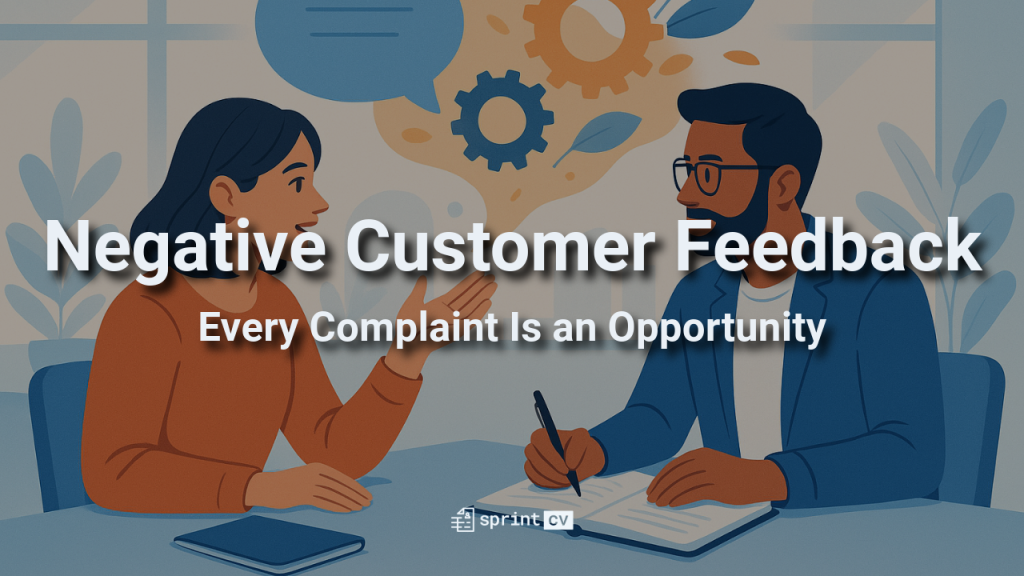

In business, one of the most powerful lessons I’ve learned is simple: there’s no such thing as bad feedback. Whether you are building a product, leading a team, or managing clients, every comment, suggestion, or complaint is an opportunity to improve. At Sprint CV, I’ve seen this first-hand. The worst thing a client can do is say nothing at all. Silence means you’ve lost your chance to learn. Complaints, on the other hand, are a gift. They mean someone still believes you can do better. Hence, we need to see negative customer feedback as an opportunity to improve.
Why Negative Customer Feedback Is the Engine of Product Development
In product development, feedback is the foundation of progress. Every insight from a customer shows how your product performs in the real world, not just how you imagined it. As founders, we often believe we know what users want, but clients frequently see things we can’t. When a customer tells you, “This doesn’t work as expected,” it’s not criticism, it’s a signpost pointing you to an area that needs attention.
It’s far better to have a client complain than one who quietly leaves. Because when they leave without saying anything, you lose both a client and an opportunity to evolve. A product that grows without feedback grows blindly.
The Restaurant Analogy: The Importance of Speaking Up
Imagine going to a restaurant and not telling the chef you are allergic to nuts. You eat, get sick, and then blame the restaurant. But if you had shared your allergy, the chef would have adapted the meal for you.
The same logic applies in business. If clients don’t share their struggles, frustrations, or unmet expectations, we cannot fix them. We can’t improve what we don’t know.
That’s why collecting feedback is not a luxury, it’s a necessity. Creating open channels of communication with clients, checking in regularly, and inviting feedback are essential for continuous improvement. The more you listen, the faster you grow.
Turning Negative Customer Feedback Into Collaboration
We’ve learned to treat every complaint as collaboration. When a client says, “The platform isn’t doing what I expected,” our first reaction is not to defend, but to understand. We respond: “Thank you for the feedback. Let’s work on this together.”
This mindset transforms what could be a conflict into co-creation. We learn about how clients really use the product, what frustrates them, and what would make their daily work easier.
For instance, a client once told us that Sprint CV felt “too complex.” At first, that feedback hurt. We had spent months refining the interface. But after observing how users interacted with it, we realized they were right. We had built it for ourselves, not for them.
That moment led to one of our biggest product breakthroughs: the creation of the AI CV Parser Mailbox, which simplified CV processing dramatically. One complaint triggered an entire wave of innovation.
The Power of Demanding Clients
Some clients are more vocal and demanding. They challenge everything, push you to justify your choices, and expect excellence every time.
But I’ve learned to value those clients the most. They push you to grow, to improve, and to raise your standards. A demanding client is not a problem: they are your unpaid product tester, your free consultant, and your best opportunity to evolve.
Some of our most innovative features were born from challenging discussions with clients who cared enough to be honest. That’s why I always remind my team: don’t fear complaints, fear silence. A complaining customer still cares. A silent one has already left.
Building a Culture That Welcomes Feedback
To turn feedback into improvement, you must build a culture that doesn’t take criticism personally. When someone points out a problem, it’s not an attack on your competence, it’s a reflection of their experience. The moment you start taking feedback personally, you stop growing. On our company, we have embedded regular feedback cycles into our process:
- After each onboarding, we ask: “Are you happy with the setup?”
- After each release, we ask: “Is there something we can improve?”
- Every few months, we check in with our biggest clients to review what’s working and what’s not.*
This proactive approach builds trust. Clients feel heard, the team gets clear direction, and the product evolves faster.
Listening to Negative Customer Feedback is Powerful
Collecting feedback is easy. Truly listening is the hard part. When we hear criticism, our instinct is to defend or explain. But that prevents us from learning. Instead of defending your product, listen to the why behind the complaint. Ask yourself:
- Why do they feel this way?
- What problem are they actually trying to solve?
- What can we improve so this doesn’t happen again?
Even when feedback feels exaggerated, there’s always a grain of truth. Your job is to find it, understand it, and act on it.
Closing the Feedback Loop
Feedback only has value if it leads to action. That’s why we follow a simple loop:
- Collect feedback.
- Identify if it’s specific to one user or common to many.
- Decide whether it should go into our development roadmap.
- Deliver improvements and inform the client who raised it.
By closing the loop, we transform feedback from words into measurable progress. Clients appreciate seeing that their voice has an impact. It builds long-term relationships and strengthens our reputation as a company that listens.

Feedback Builds Trust and Relationships
When clients give feedback and see you act on it, they feel respected and involved. It turns them from customers into collaborators. Even when the feedback is tough, responding with transparency and action builds credibility. It shows that your company prioritizes improvement over ego.
Over time, those small actions build loyalty. Clients begin to trust that if something isn’t right, you’ll listen and fix it. That kind of trust is worth more than any marketing campaign.
Shifting Mindset: From Negative to Positive
The biggest change comes from how you perceive feedback. Stop labeling it as “negative.” Start calling it what it is: an opportunity to improve. This small shift changes everything.
Instead of frustration, you feel curiosity.
Instead of defensiveness, you feel gratitude.
Instead of stress, you feel empowered.
Here, we celebrate feedback. We thank our clients for it, even when it’s uncomfortable. That’s how we’ve managed to continuously evolve and grow stronger as a product and as a team. Companies that learn the fastest are the ones that listen the most.
The High Cost of Ignoring Negative Customer Feedback
Ignoring feedback doesn’t make it disappear: it makes it dangerous. When customers tell you something isn’t working and you don’t act, they won’t tell you again. They’ll quietly look for alternatives.
By the time you realize they’re gone, the damage is done. You’ve lost not only revenue but also the insight that could have saved you. Every complaint, every suggestion, and every question is a free lesson from the market. Ignoring it is like throwing away the answers to your own success.
Feedback Is Growth
If I could summarize years of product development and customer relationships in one sentence, it would be this: there’s no bad feedback, only opportunities to improve.
The best clients aren’t the ones who say, “Everything’s perfect.” They’re the ones who say, “Here’s how you can make it better.” Every complaint is a sign that someone still cares enough to speak up. Every suggestion is a chance to make your product stronger. So don’t fear criticism. Welcome it. Don’t take it personally. Learn from it.
Because at the end of the day, the most successful companies aren’t the ones that avoid feedback: they’re the ones that embrace it, act on it, and grow from it. And that’s exactly how we build: one conversation, one improvement, and one happy client at a time.
Why don’t you give us some feedback? Check out our features and tell us where to improve!
Cloud Software
Berita Olahraga
Lowongan Kerja
Berita Terkini
Berita Terbaru
Berita Teknologi
Seputar Teknologi
Berita Politik
Resep Masakan
Pendidikan


