
AI in recruitment is all about using smart technology to automate and sharpen up the hiring process. Think of it as a powerful assistant that takes on the heavy lifting: the high-volume, repetitive work like screening hundreds of CVs or scheduling interviews. This frees up recruiters to focus on what they do best: building real relationships with candidates. The end goal? A faster, smarter, and more efficient hiring cycle.
How AI for Recruitment Actually Works
Imagine your hiring process, but without the bottlenecks. Instead of starting your day by staring down a mountain of résumés, you open your inbox to find a curated shortlist of the top 10 candidates already waiting. This isn’t some far-off fantasy; it’s what AI for recruitment makes possible today.
Think of AI as your most dedicated team member, working 24/7 to handle the time-sucking tasks that slow you down. It takes over the grunt work, allowing your team to zero in on what truly matters: connecting with great people.
From Overwhelmed to Empowered: A Recruiter’s Story
Let’s look at Sarah, a senior recruiter at a fast-growing tech company. She posts a new software engineer role, and within 48 hours, her inbox is overflowing with more than 500 applications. Manually reviewing each one would take her an entire week of eight-hour days, pushing back deadlines and risking top candidates getting snapped up by competitors. Her calendar is already packed, and the thought of another week lost to just screening is overwhelming.
This is where AI changes the game. Instead of wrestling with hundreds of PDFs, Sarah uses an AI-powered system that instantly parses and analyzes every single application. The system goes beyond simple keyword matching; it actually understands context. It knows a candidate with “Java and Spring Boot” experience is a strong fit, even if their CV doesn’t list the exact job title. In less than an hour, the AI has done what would have taken her a full week.
The real power of AI here isn’t replacement, it’s empowerment. By automating the initial screening, AI frees recruiters from administrative quicksand, turning weeks of manual work into just hours of focused, high-impact activity.
Beyond Keywords to True Potential
The AI platform serves up a ranked shortlist of the 20 most qualified candidates. It highlights specific skills, years of relevant experience, and even flags people from her company’s existing talent pool who are a perfect match for this new role.
This allows Sarah to pour her energy into the human side of recruiting:
- Engaging directly with the most promising candidates right away.
- Building genuine relationships and getting to know their career ambitions.
- Conducting thoughtful interviews to see if they’re a good cultural fit.
Ultimately, AI gives recruiters the gift of time. By handling the tedious first steps, it lets them focus on making smart, strategic hiring decisions. If you’re looking for more ways to bring in technology without losing that personal touch, our guide on the role of AI in tech recruitment offers some great advice. Sarah’s story makes it clear: AI for recruitment isn’t about replacing people; it’s about amplifying their expertise.
AI Tools That Actually Get the Job Done

Alright, let’s get past the buzzwords and look at the actual tools that bring AI for recruitment into the real world. These aren’t far-off concepts; they are practical solutions that tackle the most persistent headaches in talent acquisition, designed to give you back your most valuable asset: time.
We’ll break down four core functions that are changing the game right now, complete with examples of how they make a recruiter’s life easier.
CV Parsing That Understands Context
Let’s say you’re hiring a “Digital Acquisition Lead.” Your applicant tracking system (ATS) is flooded with CVs from “Growth Hackers,” “PPC Specialists,” and “Demand Generation Managers.” A traditional keyword search would likely miss these incredible candidates, forcing you to spend hours manually sifting through applications just to connect the dots.
This is where AI-powered CV Parsing comes in. Think of it as a hyper-intelligent search engine that understands context, not just keywords. It knows that the skills of a growth hacker are highly relevant to your digital acquisition role, even if the job titles don’t match perfectly.
This kind of tech is quickly becoming essential. The AI recruitment sector is projected to grow steadily with a compound annual growth rate of 6.17% from 2023 to 2030. This isn’t surprising, especially when you consider that between 35% and 45% of companies are already using AI to improve their hiring.
Instead of just matching words, AI matches intent. It understands that a candidate who managed a multi-channel ad budget and optimized conversion funnels is a strong match, regardless of their official job title.
This capability is the engine behind tools like an AI CV parser, which can instantly pull out and categorize skills from hundreds of different CV formats in seconds.
Automated Communication and Scheduling
Meet David, a recruiter who used to dread the “scheduling shuffle.” For every new role, he had to coordinate interviews between five candidates and three different hiring managers. His week was a blur of emails: “Does Tuesday at 2 PM work?” followed by “Sorry, Sarah’s booked then. How about Wednesday morning?” It was a full-time job in itself, taking up nearly a quarter of his workweek.
AI-driven communication tools completely wipe out this administrative nightmare. Now, David simply triggers the scheduling process. The AI takes over:
- It sends personalized outreach to each candidate with a link to the team’s shared calendar.
- It finds mutually available time slots without any manual coordination.
- It automatically books the meeting and sends confirmation emails to everyone.
What used to take David an entire afternoon of tedious back-and-forth now happens in about 15 minutes. He sets it up, walks away to grab a coffee, and comes back to a fully booked interview schedule. That’s hours of his week reclaimed for sourcing and building candidate relationships. And as we already know, time is one of David’s most valuable assets!
Intelligent Talent Rediscovery
Your ATS is probably a goldmine of untapped potential. It holds thousands of “silver medalist” candidates – people who were strong contenders for past roles but weren’t the final choice. Maybe two years ago, you interviewed Maria, a promising junior analyst who just wasn’t ready for a senior position. Today, with two more years of experience, she might be the perfect fit for your new opening.
The problem? Finding her again is like searching for a needle in a haystack.
AI-powered talent rediscovery changes that. It proactively scans your entire database, flagging past applicants whose skills and experience now align perfectly with your open roles. One staffing agency used this to fill a senior consultant position in just three days. The AI surfaced a candidate from their database who had applied 18 months prior. With two more years of experience under her belt, she was now the ideal candidate, saving the company thousands in sourcing fees and weeks of searching. You can do this with Sprint CV AI-powered Job Board!
Interview Intelligence and Analytics
Making fair and consistent hiring decisions is one of the toughest parts of recruitment. Unconscious bias can creep in, and it’s difficult to objectively compare candidates based on scribbled interview notes alone.
Interview intelligence platforms add a data-driven layer to your evaluation process. These tools can record and transcribe video interviews, then analyze the content for key indicators of success.
This technology doesn’t make the hiring decision for you. Instead, it provides objective data points to support your team’s judgment. It ensures every candidate is evaluated against the same criteria, helping you build a more diverse and skilled workforce based on merit, not just gut feelings.
Manual vs AI-Powered Recruitment Tasks
To really bring this home, let’s look at the time savings in black and white. When you remove the manual grind from everyday tasks, recruiters are free to focus on what they do best: building relationships.
| Recruitment Task | Time Spent (Manual Process) | Time Spent (With AI) | Efficiency Gain |
|---|---|---|---|
| Initial CV Screening | 4–6 hours per 100 CVs | 15–30 minutes | Up to 95% |
| Scheduling Interviews | 2–3 hours per role | 10–20 minutes | Over 90% |
| Talent Rediscovery | 5+ hours (often not done) | Under 10 minutes | Activates hidden value |
| Candidate Data Entry | 5–10 minutes per CV | Under 30 seconds | Over 90% |
The numbers speak for themselves. This isn’t about replacing recruiters; it’s about empowering them. By automating the repetitive tasks, you’re not just saving hours – you’re reinvesting that time into high-impact activities that drive better hiring outcomes.
Real-World Examples of AI for Recruitment in Action
Let’s move past the theory and look at how this actually works. It’s one thing to talk about AI, but it’s another to see the real-world impact it’s having on hiring teams right now. These stories show how companies are turning hiring bottlenecks into genuine breakthroughs, freeing up their recruiters to do what they do best: connect with people.
Slashing Time-to-Hire at a Tech Startup
First up, let’s talk about Innovate, a fast-growing tech startup constantly fighting for top engineering talent. Their biggest problem? Speed.
Their manual process was painfully slow, with the average time-to-hire for a senior software engineer stretching to a brutal 55 days. In the tech world, that’s an eternity. They were losing fantastic candidates to competitors who could simply move faster. Their recruiting team felt like they were drowning in applications, spending the first two weeks of any search just screening CVs.
To fix this, they brought in an AI platform to automate the initial screening and interview scheduling. The change was immediate. The AI could sift through hundreds of applications in minutes, pinpointing the top prospects based on very specific technical skills. Better yet, it would then reach out to those candidates to get interviews on the calendar, cutting out days of administrative back-and-forth.
By automating the top of their hiring funnel, Innovate cut its time-to-hire from 55 days down to just 22 days—a 60% reduction. Suddenly, their recruiters weren’t buried in admin. They could focus on building solid relationships with high-value candidates from day one.
Unlocking Hidden Value at a Global Enterprise
Now, picture Global Logistics, a massive company with a huge applicant tracking system (ATS) holding over a million candidate profiles. You’d think that would be a goldmine, right? But in reality, their recruiters still spent a huge chunk of their budget on external sourcing agencies. Why? Because finding those “silver medalist” candidates from past searches was almost impossible.
Their challenge was talent rediscovery. They knew great people were sitting in their database, but they had no efficient way to find them.
So, they integrated an AI talent rediscovery tool with their ATS. The AI constantly scanned their existing talent pool against new job openings, instantly flagging qualified people who had applied for different roles months or even years earlier.
This one change made a massive difference to their bottom line. In the first year alone, Global Logistics filled 25% of its open positions with candidates they rediscovered from their own database. This saved the company over $300,000 in external hiring costs and dramatically shortened the sourcing cycle for dozens of roles.
The infographic below really brings to life how these AI-driven changes improve time, talent discovery, and cost.
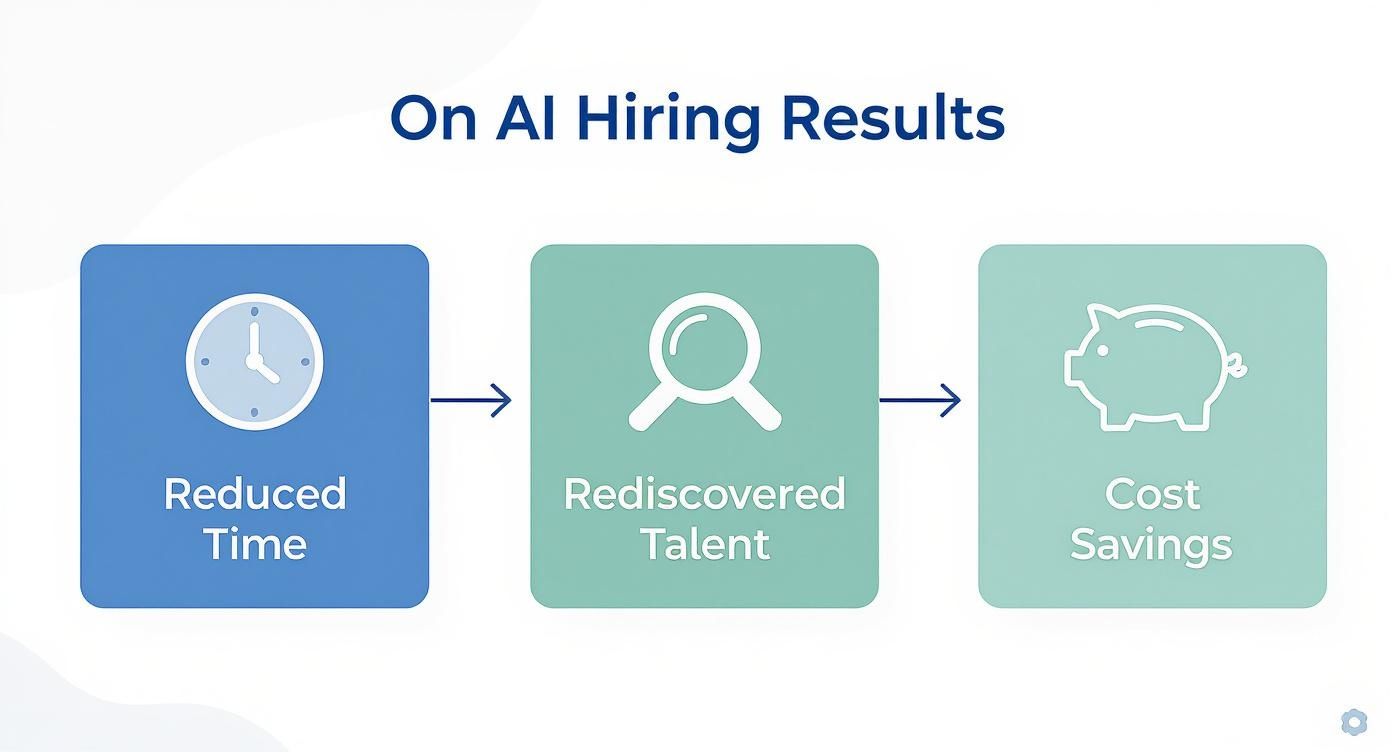
As you can see, these benefits are all connected. Faster hiring and better use of existing talent naturally lead to big financial savings.
The Accelerating Adoption of AI for Recruitment – Hiring
These stories aren’t just one-offs; they’re part of a much bigger shift. The use of AI for recruitment is picking up speed as more and more organizations see the clear business case for it.
The numbers don’t lie. Recent data shows that in 2025, 43% of organizations globally used AI for HR tasks, a huge jump from just 26% in 2024. This growth is all about results. For example, companies using AI-assisted communication were 9% more likely to make a quality hire than those with low AI usage. In fact, an incredible 99% of hiring leaders reported using AI in some form during their recruitment process in 2025. If you’re curious, you can discover more insights about these AI recruitment statistics and what they mean for the industry.
This data just confirms what companies like Innovate and Global Logistics already figured out. Bringing AI into your hiring process is no longer some futuristic idea: it’s a practical, proven way to build a more efficient, cost-effective, and successful talent team today.
Your Roadmap for Implementing AI for Recruitment
Bringing new technology into your daily grind can feel like a massive undertaking. But here’s the thing: a successful AI for recruitment rollout doesn’t require you to tear everything down and start over. It’s about making smart, targeted upgrades that solve real problems.
This roadmap is designed to guide you through a smooth, step-by-step implementation without throwing your team’s rhythm off course. The key? Start with a clear problem you need to solve. Don’t chase the shiny new tech; let the tech fix a genuine pain point for your team.
Step 1 – Pinpoint Your Biggest Bottlenecks
Before you can pick the right tool, you have to know exactly where the friction is. Where does your team lose the most time and energy? Is it the flood of initial applications, the endless email chains trying to schedule interviews, or the black hole of past candidates in your ATS?
Take a minute and map out your current workflow. One of our clients, a mid-sized consulting firm, had their recruiters manually reformatting every successful candidate’s CV into the company’s branded template before sending it to a client. They discovered the team was collectively sinking over 20 hours per week on this single task. It was a monster time-sink, and they didn’t even realize how bad it was until they looked.
Not sure where to start? Use this checklist to find your primary bottleneck:
- Initial Screening: Are you drowning in applications for every open role, struggling to find the gems?
- Interview Scheduling: Does playing calendar Tetris for candidates and interviewers eat up a huge chunk of your day?
- Sourcing: Do you struggle to find qualified people and end up leaning on expensive external agencies?
- Data Management: Is your ATS a chaotic mess of unstructured data, making it impossible to find anyone or anything?
Once you’ve identified your biggest headache, you have your starting point. This focused approach makes everything more manageable and guarantees you’ll see an immediate, tangible impact.
Step 2 – Start Small and Prove Value
Now that you know the problem, resist the urge to buy a massive, all-in-one AI platform that promises the world. The most successful rollouts begin with a single, high-impact tool that directly attacks the bottleneck you just identified.
For that consulting firm, the answer was an AI-powered CV Parser and CV Generator. It was a laser-focused solution for their specific, painful problem. Within the first month, they reclaimed those 20 hours per week. That’s the equivalent of hiring a new part-time employee, just by adopting one smart tool.
By solving one major pain point first, you create a powerful success story. This early win makes it infinitely easier to get buy-in from your team and leadership for future AI investments.
When your team sees firsthand how one simple tool can save them hours of grunt work every week, they stop being skeptics and start being champions for the new tech.
Step 3 – Prepare Your Data and Systems
Your new AI tool will only be as good as the data you feed it. Before you plug anything in, you need to make sure your existing systems, particularly your Applicant Tracking System (ATS), are ready for it. Think of it as a bit of digital housekeeping.
This step is absolutely critical for a seamless integration. If your new tool can’t talk to your ATS properly, you’ll just end up creating more manual work for your team—which defeats the whole point.
- Clean Up Your Data: Archive old, irrelevant candidate profiles. Standardize data entry fields where you can. A little cleanup goes a long way.
- Check for Integration: Confirm that your chosen AI tool offers a straightforward, no-fuss integration with your current ATS.
- Talk to Your Vendor: Ask potential vendors about their implementation process. What support do they provide to ensure a smooth connection?
Step 4 – Lead the Change and Showcase Success
At the end of the day, successful adoption is all about people. You need to manage expectations, provide clear training, and, most importantly, celebrate the early wins to get your team genuinely excited.
Start by explaining the why. Make it clear that the goal is to eliminate tedious work, not to replace anyone. Frame it as a way to free them up so they can focus on the more strategic (and rewarding) parts of their job.
Then, hold a training session and show them a real “before and after.” For example, manually format a complex CV and time how long it takes. Then, use the AI tool to do the same task in seconds. Seeing that time savings right in front of them is the most powerful demo you can give. This approach turns a potentially intimidating change into a welcome upgrade for everyone.
How to Measure Your AI for Recruitment Success
Investing in new technology is one thing; proving it’s actually working is another. To build a compelling case for your investment in AI for recruitment, you need to move beyond anecdotes and focus on cold, hard data. Measuring success isn’t just about efficiency; it’s about showing a clear business impact that leadership will understand and value.
The key is to establish a baseline. Before you flip the switch on any new AI tool, you need to know your current numbers. Once you have that “before” picture, you can accurately track the “after” and tell a powerful story with your results.
The Three Pillars of AI for Recruitment ROI
To prove the value of your AI tools, focus on three core metrics that tie directly to strategic business goals. These key performance indicators (KPIs) show how AI is making your hiring process faster, cheaper, and better.
1. Time-to-Fill
This is the classic recruitment metric, measuring the total days from when a job is posted to when an offer is accepted. AI dramatically shortens this cycle by automating the top of the funnel.
Imagine your average time-to-fill for a technical role is 48 days. After implementing an AI screening tool, you find that number drops to 30 days. That 18-day reduction is a direct result of faster screening and scheduling, letting your team engage top candidates before competitors even get a chance. This means the new developer starts contributing to a critical project three weeks sooner, delivering tangible value to the business faster.
2. Cost-per-Hire
This metric calculates the total cost of filling a role, including advertising spend, agency fees, and your team’s time. AI chips away at this number by reducing your reliance on expensive external sources and getting more value out of the assets you already own, like your candidate database.
For instance, a company might spend an average of €5,000 per hire, with a big chunk of that going to sourcing agencies. By using an AI talent rediscovery tool to fill roles from their internal database, they might slash that cost by 40%, saving €2,000 for every position filled that way. After ten such hires, that’s a real saving of €20,000 that can be reinvested elsewhere.
3. Quality-of-Hire
This is the ultimate measure of success, tracking the long-term performance of the people you bring on board. It’s often measured through first-year performance reviews, manager satisfaction surveys, and retention rates after one year.
Quality-of-hire proves that AI isn’t just finding candidates faster; it’s finding the right candidates. A higher retention rate for AI-sourced hires directly translates to lower turnover costs and a more stable, productive workforce.
Your Simple Measurement Framework
Tracking your KPIs is the first step, but presenting them clearly is what gets you buy-in from the rest of the business. The table below outlines the essential metrics you should be tracking to demonstrate the return on your AI investment.
Key KPIs for Measuring AI Recruitment ROI
| Metric | How to Measure It | Why It Matters |
|---|---|---|
| Time-to-Fill | Average number of calendar days from job requisition approval to offer acceptance. | A shorter cycle means less productivity lost to vacant roles and a better chance of landing top talent before competitors. |
| Cost-per-Hire | Total recruitment costs (internal and external) divided by the number of hires. | Shows direct financial savings from reduced agency fees, ad spend, and administrative overhead. |
| Quality-of-Hire | A composite score from manager satisfaction surveys, 90-day performance reviews, and first-year retention rates. | Proves that speed and cost savings aren’t coming at the expense of talent quality. Higher quality hires drive business performance. |
| Source-of-Hire | Percentage of hires coming from internal databases vs. external sources (job boards, agencies). | Highlights the value of your existing talent pool and the AI’s ability to surface qualified, internal candidates. |
| Candidate Satisfaction (CSAT) | Scores from post-application or post-interview surveys (e.g., Net Promoter Score). | Measures whether automation is improving the candidate experience by providing faster, more consistent communication. |
By benchmarking these numbers before and after you implement your new AI for recruitment tools, you create a simple, data-driven narrative that removes all guesswork. It provides a clear, undeniable picture of the strategic value your AI tools are delivering, making it easy to justify continued investment and expand its use across your organization.
Navigating Ethics and Bias in AI for Recruitment – The Hiring Scenarios

Bringing AI for recruitment into your workflow isn’t just a technical upgrade; it comes with a serious responsibility. The biggest worry is a simple one: if an AI learns from biased historical hiring data, it can easily learn to repeat those same mistakes, filtering out fantastic candidates for all the wrong reasons.
Imagine an AI trained on a decade’s worth of hiring data from a company that, consciously or not, favored male candidates for leadership positions. The algorithm might start to associate male-coded language or experience with success, accidentally pushing highly qualified female applicants to the bottom of the pile. This is exactly why ethical oversight is non-negotiable.
But the story isn’t all doom and gloom. In fact, when designed and implemented correctly, modern AI can become a powerful tool for reducing human bias, not making it worse.
Using AI as a Tool for Inclusion
A well-built AI platform can be programmed to completely ignore demographic information. It doesn’t see names, gender, age, or ethnicity. Instead, it’s laser-focused on objective, measurable data points like skills, specific experiences, and qualifications that actually matter for the role.
By stripping away the subjective factors that can trigger our own unconscious biases, AI effectively levels the playing field. It forces every evaluation to be based purely on merit, which naturally leads to a more equitable and diverse candidate pipeline.
For instance, many forward-thinking teams are now using tools to anonymize CVs before review, ensuring that the initial screen is completely impartial. This gets to the core of ethical AI – making sure every single candidate gets a fair shot based on what they can do, not who they are.
Your Vendor Vetting Checklist
Choosing the right AI partner is probably the most critical step you’ll take in building an ethical hiring process. Not all AI tools are created equal, and you absolutely must ask tough questions to make sure a vendor’s tech aligns with your commitment to fairness.
Use this checklist when you’re talking to potential AI vendors:
- Data Transparency: Ask them point-blank what data their models are trained on. Can they prove it’s diverse and representative of the talent pool you want to attract?
- Bias Auditing: How do they test their algorithms for bias? Do they have a third party audit their systems for fairness, and how often?
- Explainability: If the AI flags or rejects a candidate, can the system explain why? A “black box” algorithm where you can’t understand its reasoning is a massive red flag.
- Human Oversight: Does the tool allow for human intervention and final decision-making? The best systems empower recruiters; they don’t try to replace them.
By making these questions a priority, you can confidently choose an AI for recruitment partner that not only makes you more efficient but also actively champions a more inclusive and fair hiring culture.
Frequently Asked Questions About AI for Recruitment
Whenever a powerful new technology shows up, it’s natural to have questions. When it comes to AI in recruitment, we hear the same key concerns from recruiters and hiring managers all the time. Let’s tackle them head-on with some straight-to-the-point answers.
Will AI Replace Recruiters?
This is the big one, isn’t it? The question on everyone’s mind. The short answer is a firm no. AI isn’t here to take over your job; it’s here to give you a serious upgrade. Think of it less like a replacement and more like a brilliant co-pilot.
AI is fantastic at the heavy lifting – the repetitive, soul-crushing tasks like sifting through thousands of CVs or trying to coordinate five different calendars. By handing that off to a machine, you get to focus on what humans do best: building real relationships, truly understanding cultural fit, and convincing a star candidate that this is the career move they’ve been waiting for. AI handles the data; you handle the people.
How Much Does AI for Recruitment Cost?
The price tag can swing pretty wildly, from a manageable monthly subscription for a small team to a major enterprise-level investment. But here’s the thing: you have to stop thinking of it as a cost and start seeing it as an investment. What’s the return?
A small staffing agency might grab a CV parsing tool for a few hundred dollars a month. That seems like a lot, until you realize it’s saving each recruiter five hours a week on mind-numbing data entry. Suddenly, that “cost” is paying for itself several times over. For bigger companies, the investment is larger, but the return is often massive, sometimes saving hundreds of thousands of dollars in agency fees or by drastically cutting down the time-to-fill for critical roles.
You can check the pricing of our Enterprise CV Management solution here.
How Can We Prevent AI from Screening Out Diverse Candidates?
This is a non-negotiable, and it’s a perfectly valid concern. The key is twofold: choose a modern, well-built AI platform and don’t be afraid to ask vendors some tough questions about bias.
A properly configured AI tool can actually reduce human bias. By focusing solely on objective skills and qualifications (and ignoring demographic data like names, age, or gender) it creates a more level playing field than a purely manual review process ever could.
When you’re vetting vendors, dig into how their algorithms are trained, tested, and audited for fairness. A partner worth their salt will be transparent and show you exactly how their tech is designed to promote equitable hiring, not hinder it.
What Is the First Step for a Small Team?
If you’re on a small team, the absolute best thing you can do is start small. Don’t try to boil the ocean by rolling out some massive, all-in-one system. Instead, pinpoint your single biggest time-waster and find a specific tool that solves that one problem.
- Drowning in CVs? Your first move should be an AI-powered résumé parser.
- Wasting hours on scheduling? Look into an automated scheduling tool.
- Struggling with sourcing? A talent rediscovery tool could be a game-changer.
By starting with one clear win, you’ll prove the value immediately and build momentum. You get a clear ROI you can show your boss, and your team gets an instant efficiency boost. That makes it much easier to expand your AI toolkit down the road. For more reading on what AI can do and answers to other common questions, Parakeet AI’s blog is a great resource with a ton of different articles and perspectives.
Ready to eliminate manual CV formatting and accelerate your hiring cycle? With Sprint CV, you can parse, standardize, and generate polished, client-ready CVs in a fraction of the time. Discover how Sprint CV can transform your workflow today! Book a free of charge demo with us.
Cloud Software
Berita Olahraga
Lowongan Kerja
Berita Terkini
Berita Terbaru
Berita Teknologi
Seputar Teknologi
Berita Politik
Resep Masakan
Pendidikan


